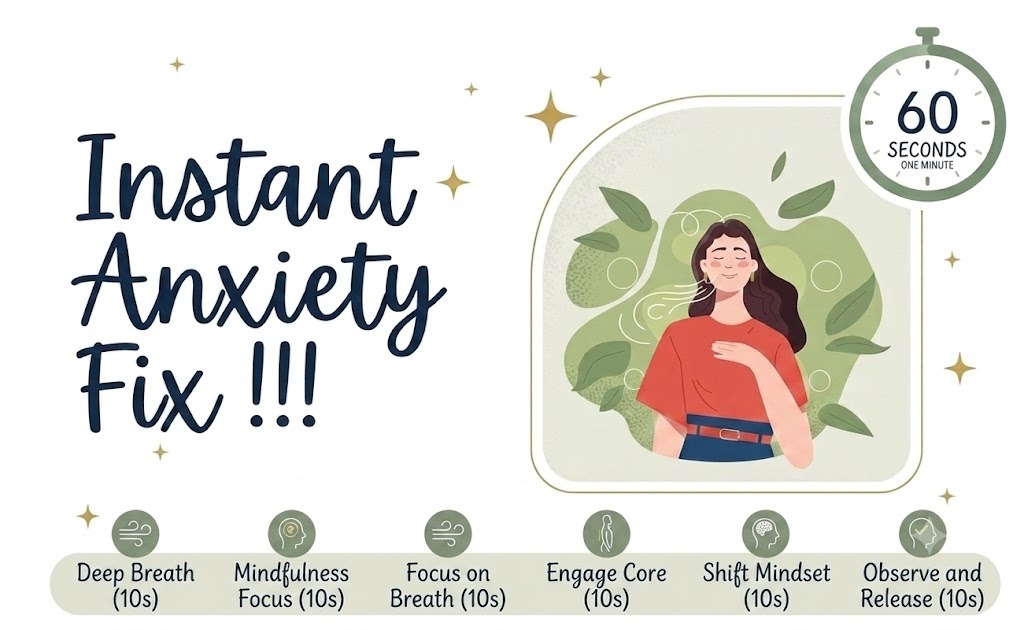
The Critical Medical Truth: Panic Is Not a Mindset Flaw
When an acute panic attack strikes—whether in traffic, during a presentation, or in bed at 2 AM—well-meaning advice tells you to "calm down" or "think positive thoughts."
As a physician, I need you to know: that advice fails because panic is not a cognitive flaw. Acute panic is a rapid autonomic runaway triggered by the sympathetic nervous system and the noradrenergic nucleus in your brainstem (the locus coeruleus). Once adrenaline floods your bloodstream, cerebral cortex reasoning cannot simply switch it off.
To stop a panic attack in real time, you cannot use psychology. You must use a mechanical brake.
The 60-Second Real-Time Sigh Pacer
Follow the 3-step rhythmic cadence below. Complete 3 consecutive cycles to trigger vagal deceleration and stabilize blood CO₂.
Deep Nose Inhale
Draw air steadily through nose to 80% lung capacity.
Second Nose Sip
Sharp extra inhale to pop open collapsed alveoli.
Long Mouth Sigh
Slow, unhurried exhale to engage the vagal brake.
The 3-Step Physiological Sigh Protocol
Documented in clinical autonomic physiology and pioneered in respiratory biology laboratories, the physiological sigh is an innate mammalian reflex that spontaneously terminates hyper-arousal. Here is how to execute it voluntarily during an acute episode:
Step 1: Deep Nasal Inhale
Draw air steadily through your nose into the lower lobes of your lungs. Fill approximately 80–90% of your total lung volume without straining. This activates diaphragmatic downward excursion.
Step 2: The Secondary Nasal "Sip"
Without exhaling the first breath, immediately take a sharp, second "sip" of air through your nose to top off the lungs to 100% capacity. This microscopic extra volume is where the magic occurs: it pops open millions of collapsed alveolar sacs via surfactant tension alteration.
Step 3: The Long Audible Mouth Exhale
Part your lips slightly and release all the air in a slow, unhurried, gentle sigh until your lungs are completely empty. The exhalation should be roughly twice as long as the inhale (approximately 6 to 8 seconds).
Surface Area Expansion & Surfactant Engagement
During rapid panic breathing, tiny pulmonary air sacs (alveoli) collapse like deflated balloons (atelectasis). The sharp second inhale forces surfactant distribution, reopening the sacs so accumulated carbon dioxide (CO₂) can be rapidly dumped on the long exhale.
The Physiology: Alveoli & Vagal Overdrive
Why does conventional "take deep breaths" advice fail so miserably during panic attacks? Because when people are instructed to breathe deeply, they typically over-inhale without extending their exhalations. This hyperventilates the blood, constricts cerebral arterioles, and worsens dizziness, paresthesia (tingling in fingers), and dread.
In contrast, the physiological sigh leverages two distinct biological mechanisms:
- 1. Complete Carbon Dioxide (CO₂) Offloading: Re-inflating collapsed alveoli creates an immediate spike in lung surface area. The following long exhale vents built-up carbon dioxide, stabilizing arterial blood pH.
- 2. The Vagal Brake (Respiratory Sinus Arrhythmia): When you exhale slowly, your diaphragm glides upward into the chest cavity. This movement compresses the thoracic space, giving your heart less physical room. Sensing this change, cardiac baroreceptors signal the brainstem to fire the vagus nerve, releasing acetylcholine onto the sinoatrial (SA) node to mechanically slow down your heart rate within seconds.
Heart Rate Variability (HRV) and Autonomic Timeline Post-Sigh
Controlled clinical trials demonstrate that just 2 to 3 consecutive physiological sighs induce statistically significant heart rate deceleration and autonomic stabilization, outperforming cognitive behavioral calming strategies during acute adrenaline spikes.
Execute no more than 2 to 3 consecutive cycles at a time. If lightheadedness appears, pause and resume normal shallow breathing for 30 seconds. The reset works via pressure dynamics, not by hyper-ventilating.
When Acute Resets Are Not Enough: Addressing Recurrent Panic
While the physiological sigh terminates acute episodes by mechanically shifting heart rate, frequent or unprovoked panic attacks often point to deeper physiological drivers—including autonomic dysregulation, subclinical thyroid dysfunction, cardiac arrhythmias, or generalized panic disorder.
You do not have to navigate chronic autonomic distress in isolation. A systematic clinical evaluation reviews your full biomarker profile, ECG findings, and circadian biology to develop a root-cause treatment roadmap.