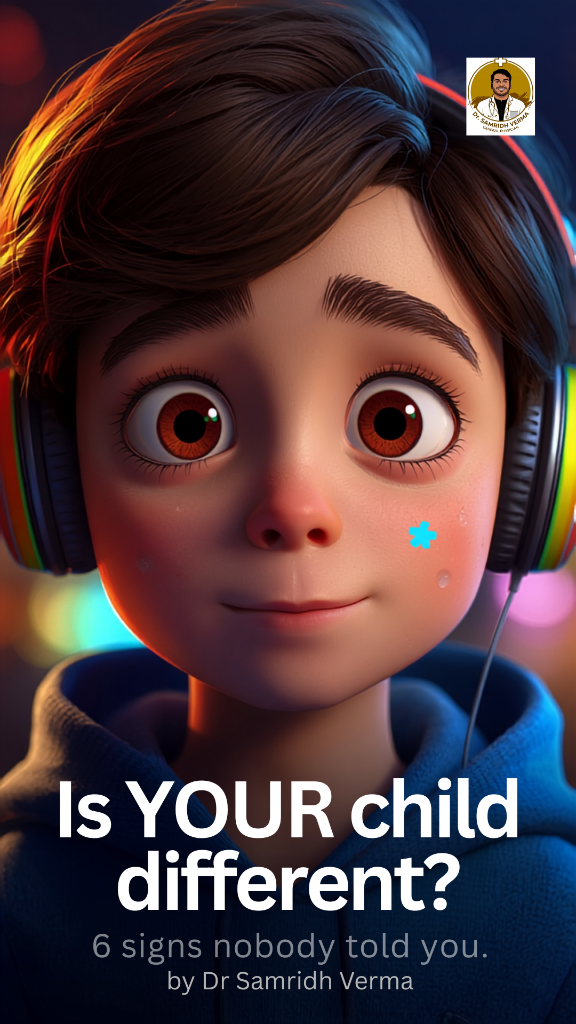
6 Subtle Signs of Autism Most Parents Mistake for Bad Behavior: A Doctor’s Compassionate Guide
It usually starts during a quiet moment after bedtime.
You find yourself sitting in the dim glow of your smartphone, scrolling through parenting forums, typing phrases like: "Why does my 3-year-old line up toy cars instead of driving them?" or "Why does my toddler scream when the grocery store freezer hums?"
Then come the well-meaning voices from family and onlookers:
"He’s just stubborn."
"She’s throwing a fit to manipulate you."
"You’re just too gentle—what that child needs is firmer discipline."
As a medical doctor, let me give you the reassurance you have been waiting to hear: You are not failing as a parent, and your child is not being "bad."
When a child’s neurological wiring processes environmental input differently, behaviors that look like defiance, indifference, or explosive tantrums to the outside world are actually involuntary distress signals.
Autism Spectrum Condition (ASC) is not a behavioral defect or a broken personality. In neurobiological terms, it is simply a different operating system—one where sensory inputs arrive amplified, social algorithms feel foreign, and predictable routines serve as vital emotional anchors.
Recognizing the early signs of autism in children is not about slapping a scary label on your toddler; it is about handing you the decoder ring to understand your child's inner world, protect their mental health, and seek supportive developmental intervention early.
Here are 6 subtle early signs of autism that most parents and educators misinterpret as behavioral issues—explained through relatable everyday metaphors.
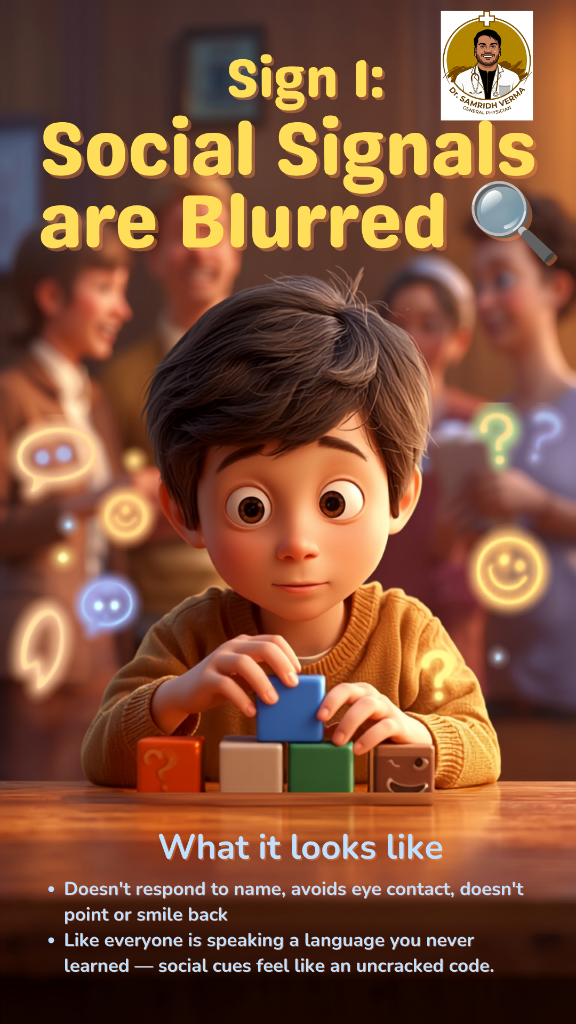
Sign 1: Social Signals Are "Blurred" 🔍
What It Looks Like in Real Life
- Your child rarely responds when their name is called—often prompting parents to worry their hearing is damaged.
- They make fleeting or uncomfortable eye contact, often looking past your shoulder, at your mouth, or staring at objects instead of faces.
- They do not participate in "joint attention"—such as pointing at an airplane in the sky to share excitement, or looking where you point.
- They struggle with social reciprocation: they may not smile back when smiled at, or they may treat other children on the playground like background furniture rather than playmates.
In Layman's Terms: The Foreign Airport Metaphor
Imagine boarding a long flight and stepping out into a bustling, crowded international airport in a foreign country where you do not speak a single syllable of the local language.
There are no signs in English. People are talking rapidly, gesturing with unfamiliar hand signals, raising their eyebrows, and expecting you to understand complex etiquette rules you were never taught.
You would feel completely disoriented. You might look away to prevent vertigo, keep your head down, and focus entirely on a mechanical map or a puzzle to self-soothe.
This is what social interaction feels like to an autistic toddler.
Neurotypical children are born with an innate, automatic social software package: they instinctively scan human eyes for emotional cues and mirror facial smiles. In an autistic child, that social translation software is not pre-installed. Eye contact can feel physically piercing or overwhelming, and social cues feel like an encrypted code. They are not ignoring you out of arrogance; their brain simply hasn't cracked the dialect yet.
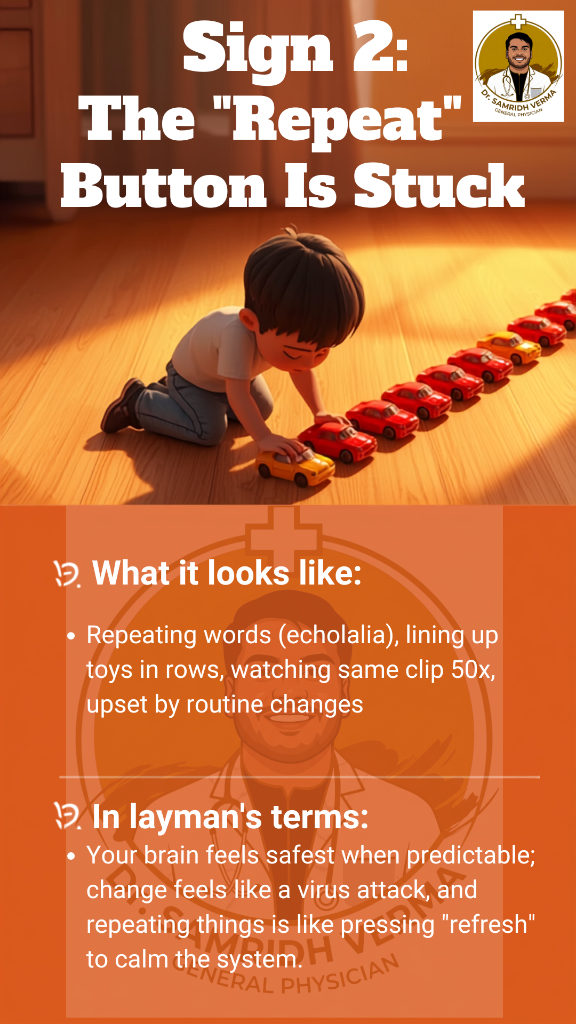
Sign 2: The "Repeat" Button Is Stuck 🔁
What It Looks Like in Real Life
- Echolalia: Repeating verbatim phrases from YouTube cartoons, movie dialogues, or questions asked to them (e.g., you ask "Do you want juice?" and they repeat "Do you want juice?" in the exact same cadence).
- Meticulously lining up toys, stuffed animals, or miniature cars in straight, unbroken rows rather than engaging in pretend play (e.g., feeding a doll or racing cars).
- Watching the exact same 15-second video clip or cartoon episode 50 times in a row without getting bored.
- Extreme, inconsolable distress over minute changes in routine—taking a different turn on the walk home from daycare, or serving lunch in a green bowl instead of the blue one.
In Layman's Terms: The Computer Safety & Refresh Metaphor
Think of your child’s brain as a high-powered computer operating in an unpredictable, chaotic environment. When too many heavy background programs are running simultaneously, the processor begins to heat up and lag.
To an autistic child, the neurotypical world is full of jarring, unpredictable surprises: people say unexpected things, lighting shifts, temperatures fluctuate, and demands change without warning.
When your computer begins to freeze, what do you do? You press the "Refresh" button (F5) repeatedly.
Lining up cars, repeating familiar Disney dialogues, or insisting on the exact same walking route is that mental "refresh" command. It brings absolute, guaranteed predictability. When a child lines up 20 cars by color, nothing unexpected can jump out and startle them. Red car follows blue car; the movie character says the exact same sentence every single time.
Repetition is their neurological sanctuary. It creates predictability in a world that feels dangerously out of control.
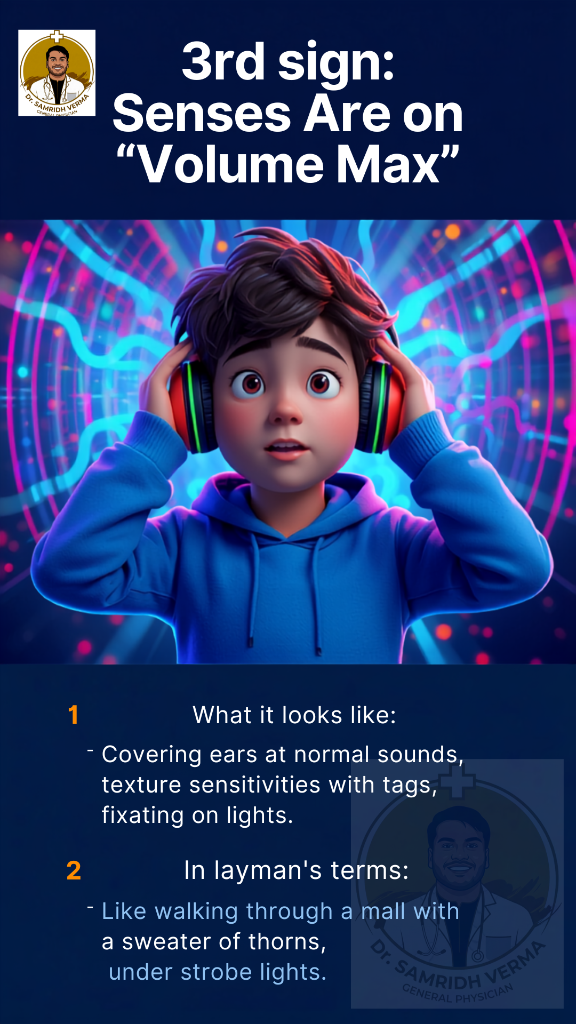
Sign 3: Senses Are On "Volume Max" 🔊
What It Looks Like in Real Life
- Clamping hands over ears or screaming at sounds most adults tune out: public hand dryers, vacuum cleaners, lawnmowers, blender motors, or supermarket fluorescent light hums.
- Intense tactile battles over clothing: crying hysterically over shirt tags, stiff denim, sock seams that touch the toes, or wet shirt sleeves.
- Extreme sensory food aversion: eating only 3 or 4 foods with identical crunch or beige color (crackers, nuggets, plain bread), and gagging at wet, slippery textures like purées or tomatoes.
- Alternatively, sensory seeking: staring unblinkingly at spinning ceiling fans, seeking deep bear hugs, crashing their bodies into sofa cushions, or constantly chewing on shirt collars.
In Layman's Terms: The Megaphone & Thorn Sweater Metaphor
In a neurotypical brain, a structure called the thalamus acts as a built-in volume knob and sensory bouncer. It filters out 90% of irrelevant background noise: you don’t feel your socks touching your ankles right now, and you don’t consciously hear the hum of the refrigerator.
In an autistic brain, that sensory filter often does not suppress baseline noise. Every sensory dial is turned to Volume 10 simultaneously.
Imagine walking into a bright shopping mall wearing a stiff sweater knitted out of prickly rose thorns, with someone blasting a blaring megaphone directly into your ear, while blinding strobe lights flicker overhead.
Could you sit calmly, smile, and follow a two-step instruction like "Please put on your shoes"?
Of course not. You would tear off the sweater and run for the nearest exit. When your child refuses to wear a collared shirt or screams inside a restaurant, they are not being dramatic or ungrateful. Their nervous system is in genuine, agonizing physical pain from sensory overload.
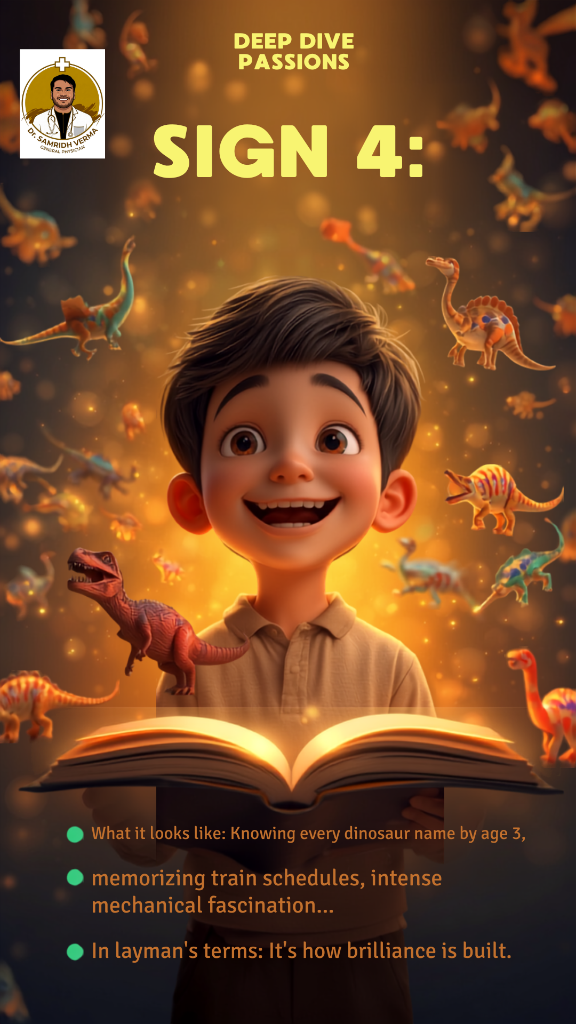
Sign 4: Deep Dive Passions 🦖
What It Looks Like in Real Life
- An encyclopedic knowledge of a single, highly specific topic: reciting every Latin dinosaur species name by age 3, memorizing elevator door motor mechanisms, understanding regional subway schedules, or analyzing vacuum cleaner models.
- Intense, laser-sharp focus that makes them oblivious to their surroundings when engaged in their special interest.
- Talking passionately for 20 minutes straight about their chosen subject without noticing whether the listener is engaged or bored (often termed "monotropic focus").
In Layman's Terms: How Brilliance Is Built
While conventional parenting advice celebrates "well-rounded" toddlers who dabble in finger painting, blocks, and balls equally, the neurodivergent brain is built on depth over breadth.
This phenomenon is called monotropism: the brain allocates 100% of its cognitive resources and processing power to a single focused channel at a time. Rather than spreading attention thinly across multiple social and environmental inputs, the child dives straight to the bottom of the ocean on their topic of choice.
Far from being an "obsession," these deep passions are a profound gift. They provide immense emotional regulation, flood the brain with calming dopamine, and lay the groundwork for incredible technical mastery later in life.
Many of the world's most transformative software engineers, botanists, physicians, and astronomers were once toddlers who simply could not stop studying dinosaurs or circuit boards.
Sign 5: The "Meltdown" vs. "Tantrum" Difference 🌋
One of the most heartbreaking experiences for parents of neurodivergent children is enduring judgmental stares in a supermarket aisle while their child screams, kicks, and writhes on the tile floor.
Strangers assume it’s a "temper tantrum." But clinically, a tantrum and an autism meltdown are governed by completely different branches of the human brain.
The Crucial Clinical Difference
| Feature | Temper Tantrum (Neurotypical) | Autism Sensory Meltdown (Neurodivergent) | | :--- | :--- | :--- | | Root Cause | Goal-oriented: The child wants a toy, candy, or control. | Neurological overload: Sensory inputs or cognitive exhaustion have crashed the brain. | | Audience Need | Requires an audience. If the parent leaves the room, the crying often pauses or checks for a reaction. | Does NOT care who is watching. The child will scream even in an empty dark room. | | Resolution | Ends immediately if the child receives the desired object or boundary holds. | Cannot be bargained with. Giving a toy or candy has zero effect. | | Physical Signs | Normal pupil size, controlled movements, mindful of self-preservation. | Dilated pupils, genuine fight-or-flight panic, potential head-banging or biting to self-regulate. | | Brain Region | Governed by the prefrontal cortex testing behavioral boundaries. | Driven by an involuntary amygdala hijack and sympathetic adrenaline surge. |
In Layman's Terms: The Overheated Engine
A tantrum is like a customer demanding a refund at a counter. It is deliberate, strategic, and subsides once the transaction is complete.
A meltdown is a total electrical blackout.
The child’s sensory processor has reached 100% capacity and overheated. Adrenaline and cortisol have flooded their circulation. During an active meltdown, the reasoning centers of their brain are completely offline.
Yelling, threatening punishments, or reasoning with "Use your words!" during an autism meltdown is as pointless as lecturing a computer monitor after the motherboard has caught fire.
How to Respond as a Parent:
- Prioritize Physical Safety: Move hard objects away, pad sharp edges, and gently prevent self-injury.
- Cut All Sensory Stimulation: Dim lights, silence music, lower your voice, and keep strangers from crowding.
- Say Less: Speak in quiet 2-word phrases: "You're safe. I'm here."
- Debrief Only After Sleep: Never analyze a meltdown right after it ends; the nervous system needs hours of quiet recovery.
Sign 6: Masking & "Restraint Collapse" 🎭
What It Looks Like in Real Life
- At preschool, daycare, or grandma’s house, your child is described as "an angel." The teacher insists: "He sits quietly, never causes a scene, and eats all his snacks!"
- But the second you buckle them into their car seat, or within 5 minutes of walking through the front door of your home, a catastrophic volcanic eruption occurs.
- They scream, throw their shoes, sob inconsolably, or hide in a dark closet for 45 minutes over seemingly insignificant triggers like being offered a peeled banana.
Parents often walk away from these episodes feeling crushed by guilt: "Why does he behave for everyone else, but hates me?"
In Layman's Terms: Holding Your Breath Underwater
Imagine being forced to jump into a deep pool and hold your breath underwater for 7 hours straight while smiling at judges on the surface.
Throughout the school day, your child is working ten times harder than their peers to mask their differences. They suppress their hand-flapping, endure screeching bell alarms, force uncomfortable eye contact, and suppress sensory panic just to avoid standing out.
They are carrying a massive, suffocating backpack of neurological tension.
When they get home and collapse, it is not because they disrespect you. It is because you are their safe harbor. You are the only place on earth where the water drains away, their armor can drop, and their lungs can finally gasp for air.
This phenomenon is known clinically as After-School Restraint Collapse. It is one of the most widely overlooked signs of autism, particularly in intelligent toddlers, girls, and children with subtle sensory profiles.
Frequently Asked Questions (Google "People Also Ask")
1. At what age do early signs of autism usually become apparent?
Early behavioral and sensory signs of autism can often be identified by experienced clinicians between 12 and 18 months of age, with definitive developmental diagnoses frequently established by age 2. Key red flags in infancy include a lack of social smiling by 6 months, absence of back-and-forth babbling or pointing by 12 months, and loss of any previously acquired words or social skills.
2. Can a child with autism make eye contact and be affectionate?
Yes, absolutely. This is one of the most damaging medical myths surrounding neurodiversity. Many autistic children love cuddles, give warm hugs to their primary caregivers, and can make eye contact—especially with people they trust deeply. Autism is a spectrum; having a warm, loving attachment to a parent does not rule out autism.
3. What is the difference between Sensory Processing Disorder (SPD) and Autism?
While sensory processing sensitivity (hyper- or hypo-reactivity to sound, touch, and light) is a core diagnostic criterion of Autism Spectrum Condition, a child can have Sensory Processing Disorder alone without meeting the full clinical criteria for autism. The key differentiator is that autism also involves differences in social communication, non-verbal reciprocation, and repetitive behavioral patterns.
4. Does early intervention genuinely make a long-term difference?
Yes. Clinical trials repeatedly demonstrate that early neurodevelopmental support—such as gentle pediatric occupational therapy, speech-language therapy, and sensory regulation strategies—capitalizes on the brain's highest period of neuroplasticity (before age 5). It equips children with functional communication tools and emotional regulation strategies before chronic anxiety and academic burnout develop.
Dr. Samridh Verma’s Closing Prescription for Parents
If you recognized your son or daughter in three, four, or all six of these descriptions, take a slow, deep breath.
Put down the late-night panic forums. A potential autism diagnosis does not change who your child is. They are the exact same bright, affectionate, unique human being they were five minutes ago before you read this article.
What changes today is your clarity. You no longer have to view their tears through the exhausting lens of "bad behavior" or parental failure. You can now view them through the compassionate lens of nervous system regulation.
If you have concerns about your child’s developmental milestones, sensory reactions, or speech trajectory, the most empowering step you can take is to schedule a professional clinical developmental assessment with a trusted physician.
Trust your parental intuition. Your child does not need to be "fixed"—they simply need to be understood.
Need a Tailored Metabolic or Sleep Protocol?
Stop managing symptoms. Get an evidence-based, 1-on-1 virtual clinical evaluation with Dr. Samridh Verma (MBBS) on Google Meet.